
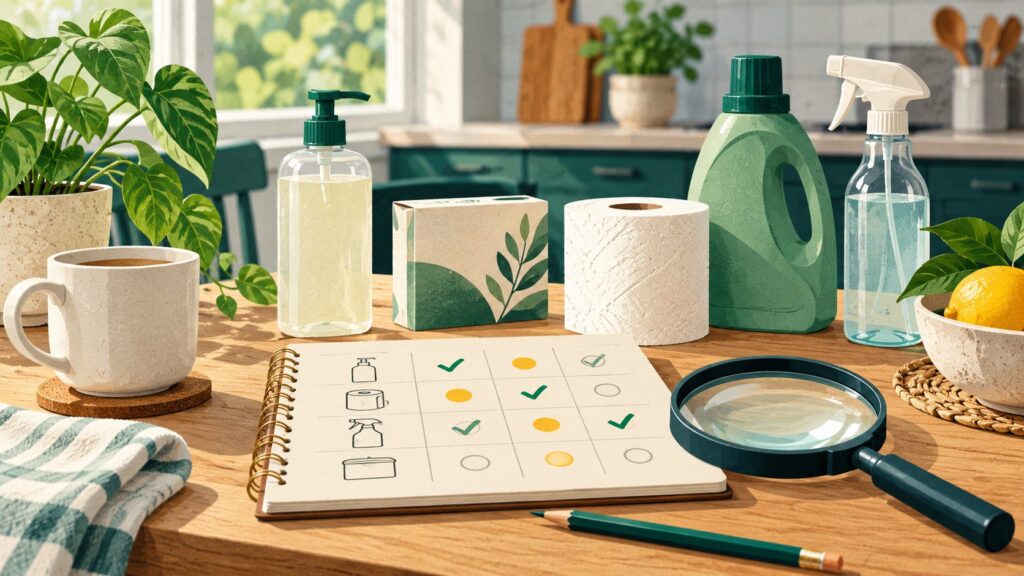
A research-led checklist for choosing family essentials on fit, safety, full ownership cost and useful features—not advertising claims.
Buying a family essential can involve comparing dozens of similar listings. This checklist helps you decide what matters before you compare prices. It is not a ranking of products and does not claim that Skint Parents has physically tested items. Prices, specifications and availability change; check the exact model and current seller terms before buying.
1. Write a short needs brief
Note who will use the item, the job it must do, how often, size or compatibility limits, storage space and your maximum total budget. Separate essential requirements from nice-to-have features. This helps you ignore bundles or upgrades that do not solve a real problem.
For example, a buggy shortlist might begin with folded dimensions, child suitability, terrain and transport needs. A household appliance shortlist might start with space, capacity, energy use and cleaning. These are comparison prompts, not product recommendations.
2. Compare like with like
Choose two or three products that meet your needs and check the manufacturer’s own specifications: dimensions, materials, weight limits, included parts, cleaning instructions and compatibility. Confirm whether accessories shown in photos are included or sold separately. Be careful with broad marketing language such as “best”, “premium” or “all-in-one” unless the listing explains exactly what it means.
Read retailer terms for delivery, assembly, warranty, returns, faults and who pays postage. If buying from a marketplace, identify whether the seller is the platform or a separate trader and keep the order confirmation. Check the applicable consumer guidance for your situation.
3. Work out the complete cost
- Purchase price and delivery or collection
- Required accessories, batteries, refills or replacement parts
- Subscriptions, installation or maintenance
- Storage and cleaning needs
- Likely resale or hand-me-down suitability, without assuming a guaranteed resale price
Do not invent a lifespan or cost-per-use figure when you do not know how long an item will last. If the product uses consumables, compare their price and availability. A low first price can still be unsuitable if essential accessories are expensive or hard to find.
4. Put safety and suitability first
For children’s products, check the intended age, size or weight range, instructions and current safety alerts for the exact model. Verify that the item is complete and compatible with your home, car or other equipment. If instructions or essential parts are missing, pause and contact the manufacturer or seller.
For baby sleep products, follow current NHS safer-sleep guidance. The NHS advises a firm, flat, waterproof mattress in a cot or Moses basket, and advises against pillows, cot bumpers and loose bedding around a sleeping baby. For child car seats, follow current law and vehicle/seat instructions; GOV.UK says children normally use an appropriate car seat until they are 12 or 135 cm tall, whichever comes first. Do not use these general points as a substitute for checking the exact product and fitting instructions.
Second-hand can be sensible for some items, but safety history matters for others. If you cannot verify condition, model, recall status or past use, do not treat a low price as a reason to take the risk.
5. Treat online reviews as one clue
Look for specific comments about the exact model and use case, and notice whether reviews are verified or incentivised where that information is shown. Repeated identical wording, reviews that discuss a different model, or praise without concrete detail may be less useful. Reviews can reveal common questions, but they cannot confirm that an item is safe for your child or will work in your home.
Separate evidence into three buckets: manufacturer specifications, independent safety or regulatory information, and customer opinions. Do not present customer comments as hands-on testing or as proof of durability.
6. Make a shortlist decision
Score each option against the needs you wrote down. Mark any safety or compatibility failure as a reason to remove it from the list rather than something to compensate for with a discount. Among suitable products, compare total cost and terms. If two options remain close, you may decide that easier cleaning, readily available spare parts or a clearer return policy matters more than an extra feature.
Reusable buying checklist
- Does it solve a genuine need?
- Is the size, age range and compatibility right?
- Have I checked current safety information and recall notices?
- What is included, and what costs extra?
- What do delivery, returns, warranty and repair terms say?
- Can I afford the total today without relying on credit I cannot repay?
- Would I still choose it if the discount label were removed?
Frequently asked questions
Are expensive family products always better?
No. Price alone does not prove quality, safety or suitability. Compare verified specifications, requirements, terms and current safety information.
Can I trust star ratings?
Use them as one signal, not a guarantee. Read specific reviews for the exact model, check review context and verify important claims independently.
Does this guide test or recommend named products?
No. This is a research-led buying framework, not a hands-on product test or current product ranking. The site’s editorial policy explains how to distinguish research from testing.
Related guides and sources
See also how to compare family essentials, baby product safety and value and how to assess a deal.
- GOV.UK: Product safety alerts, reports and recalls
- NHS: Safer sleep advice for babies
- GOV.UK: Child car seat rules
General buying information only. It is not a substitute for product instructions, individual safety advice or legal advice. Verify current details before purchase.