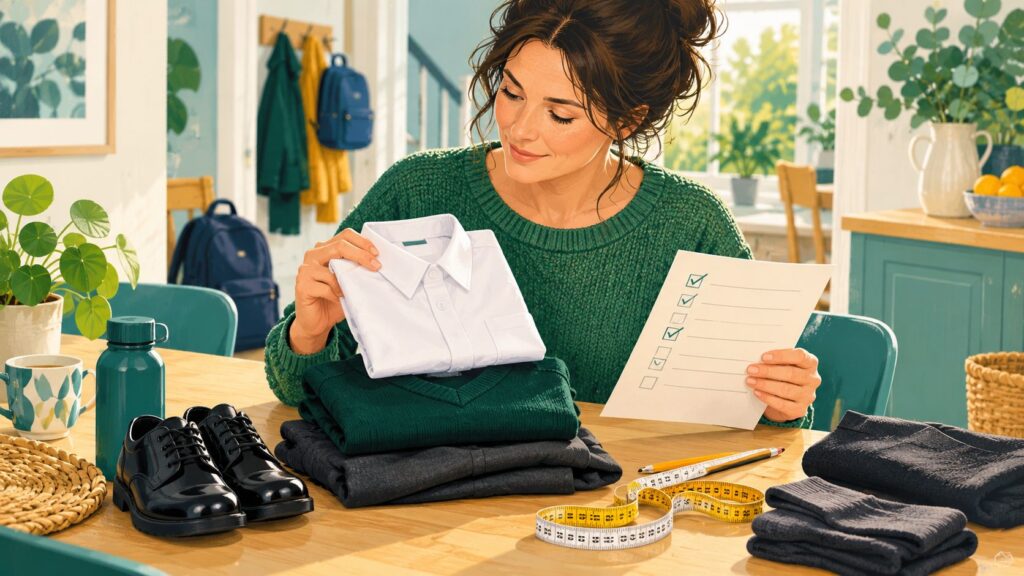
School uniform can become expensive when families buy everything at once, choose poor-value items or discover too late that they bought more than the child actually needs.
Start with the school’s current policy
Check which items genuinely need branding and which can be bought as standard garments. Requirements vary, so use the school’s current information rather than another parent’s old list.
Prioritise fit and durability
The cheapest item is not good value if it needs replacing quickly. Consider fabric, washing requirements, likely wear and whether there is sensible growing room.
Use second-hand schemes
Many schools, parent groups and local communities circulate good-condition uniform. This can be particularly useful for branded items that children outgrow before wearing out.
Label everything
Lost jumpers and coats create avoidable replacement costs. Clear labelling is one of the simplest ways to protect what you have already bought.
Do not overbuy before term starts
Start with a practical quantity and learn what the child actually uses. You can add items later if necessary.
Plan for the next replacement
School costs are predictable even when the exact size is not. Consider including uniforms in a family sinking fund.
A step-by-step uniform plan: confirm the rules, buy only what is needed, use second-hand options safely and ask the school about support early.
Uniform costs can arrive in one painful burst just before term. Children grow, requirements differ between schools and the cheapest item is not always the best value if it has to be replaced quickly. Start with the current school information rather than an old list or another family’s assumptions.
Get the current uniform policy before buying
Check the school website or ask the office for the current policy and list. Mark each item as compulsory, optional, branded or generic, and note when it is needed. Confirm colours, PE kit, footwear, coat expectations, seasonal items and whether a logo is required. Ask whether a standard high-street garment is acceptable and whether the school expects the item to be bought from one supplier.
If the school has changed its policy, ask which items remain usable and when any change takes effect. Do not replace items that still meet the rules simply because a new catalogue or promotion has arrived.
In England, Department for Education guidance on the cost of school uniforms was updated for 2026 and includes limits on compulsory branded items from September 2026. This applies to England; education policy differs across the UK. Check the current England guidance and your school’s own published policy rather than assuming rules for one nation apply everywhere.
Sort what you have before making a list
Bring all the uniform together and check size, condition, fit and whether each item is still required. Try things on with enough time to exchange sizes. Label items that are in good condition but easy to confuse. Set aside repairs, hand-me-downs and garments that may fit later, and list only what is genuinely missing.
Ask older siblings, relatives or trusted local groups whether suitable items are available. Many schools, parent groups and councils run second-hand uniform exchanges or sales. Check opening dates, collection methods and whether the item can be inspected. Some families prefer to access pre-owned uniform discreetly; ask the school office privately if needed.
Prioritise the purchases
Separate items needed on the first day from those needed later. Buy the first-week essentials first and leave optional or seasonal items until you know they are required. Start with a practical quantity for washing routines and school days; you can add another item later if the child genuinely needs it.
For branded items, compare the school supplier with second-hand stock, swap schemes and any approved alternatives. Check what makes an item count as branded: it may be a unique colour or design, not only a logo. In England, current guidance says schools should make information about second-hand uniform accessible; exact responsibilities and policies elsewhere may differ.
Compare quality and total cost
Look at fabric, stitching, fastenings, wash instructions, durability and how quickly the child may grow. A low price is less useful if an item needs frequent replacement, but an expensive “premium” label does not prove it will last. Compare the cost per item over the time it is likely to be used, while staying within money available now.
Check return and exchange policies before removing labels or washing clothes. Keep receipts together and mark the deadline. For shoes, fit and comfort matter; avoid buying a size too large if it affects safety or makes the child uncomfortable. If a child has sensory or medical needs, speak with school about practical adjustments rather than buying several unsuitable alternatives.
Ask about help before the deadline
If uniform is unaffordable, contact the school office or pastoral team as soon as you can. Ask whether there is a second-hand scheme, hardship fund, payment arrangement, clothing grant information or other support. Availability varies by school, council and nation, and not every family will qualify. You do not need to wait until the first day of term to explain that the cost is a problem.
Be specific about what is missing and when it is needed. Ask if the child can attend while you arrange the item, and get the answer in writing if the situation is unclear. If you are worried about a policy requirement or cost, follow the school’s published complaint process and ask the council or relevant education authority what guidance applies in your nation.
Protect the items you buy
Label clothing and PE kit clearly, including coats and lunch bags if these are often misplaced. Follow washing instructions and check for repairs before a small tear becomes a replacement. Keep a note of sizes and the supplier that worked well for next year, but do not purchase ahead unless you are confident the item will still fit and the policy will not change.
A simple uniform budget
| Item | Required now? | Already owned? | Plan |
|---|---|---|---|
| Branded item | Check policy | Check fit | Supplier / second-hand / ask school |
| Generic shirt or trousers | Count school days | Sort and label | Buy only missing quantity |
| PE kit and footwear | Check timetable | Check condition | Confirm exact specification |
| Optional extras | Confirm optional | Use what fits | Wait unless needed |
If you spread school costs through the year, our sinking-funds guide shows a simple planning method. If the whole household budget is short, review the family budget and check possible support through the GOV.UK benefits calculators. Estimates are not award decisions, and local help differs.
Uniform should help a child take part in school. Planning and asking early can make the cost more manageable, but the family should not be left alone to solve an unaffordable requirement. This guide is general information and not a guarantee of a grant or school decision.
Choose a quantity that matches your week
There is no universal number of shirts, trousers or socks that every child needs. Think about how often laundry is done, whether the school has separate PE days, how messy the child’s activities are and whether drying space is limited. A family able to wash midweek may need fewer spare items than one that does laundry once a week. Start with what is affordable and workable rather than buying a large bundle because it is labelled a “complete set”.
Check school rules about footwear, coats, hair accessories and PE kit before spending. If an item is only recommended, decide whether it is genuinely useful for your child. If a child grows quickly, buying one replacement at a time may be safer than stocking several sizes in advance. Keep a small note of the current size, what fits well and which items wear out first.
Make second-hand purchases practical
For ordinary garments, inspect seams, zips, stains, thinning fabric, missing buttons and signs of heavy wear. Check the label and size, but also compare measurements if the child cannot try it on. Ask whether the item came from a smoke-free home if that matters to your household. For branded pieces, confirm the logo and colour still match the current uniform policy. A low price is not a saving if the item cannot be worn.
Where possible, arrange a school swap or buy from a local group with a clear collection point. Wash items according to their labels before use and label them for school. Avoid paying a high price for an item simply because it is branded; compare the cost and expected useful life with an approved generic alternative.
Plan for sensory, disability and medical needs
Standard uniform can be difficult for children with sensory sensitivities, mobility needs, skin conditions or other disabilities. Before buying several versions, speak with the school’s inclusion, pastoral or special educational needs contact about reasonable practical adjustments. Explain the specific difficulty—for example, a fabric seam, fastener, shoe type or changing arrangement—and ask what alternatives are acceptable. Requirements and arrangements differ between schools, so get the agreed option in writing where possible.
Consider adaptations that keep the uniform usable, such as softer layers underneath, an alternative approved fastening or a small repair. Check with the school before altering a branded garment or buying an expensive specialist item. If an item causes pain or prevents participation, tell the school rather than repeatedly replacing it.
Keep a simple replacement and exchange record
Put receipts and online order confirmations in one folder, and write down exchange deadlines. Try new garments on promptly, before tags are removed. When something is outgrown, decide whether it can be passed to a sibling, donated to the school scheme or kept as a spare. Store clean items together by size and label the bag; this makes hand-me-downs useful instead of another pile to sort during a rushed week.
At the end of each term, check shoes, PE kit and fastenings. A small repair may extend an item’s useful life, while a note about a repeatedly worn-out garment can guide next year’s quality choice. Do not buy a full new wardrobe because of one change in size; replace what is actually required.
If support is needed, ask specific questions
When contacting the school, you could say: “We can provide the standard items but cannot afford the branded PE top this month. Is there a swap, second-hand stock or an approved alternative?” A specific request can be easier to answer than a general statement that uniform is unaffordable. Ask about application dates and documents if a council or school grant exists; schemes, eligibility and application windows differ across the UK. Never assume a grant is guaranteed or delay talking to school while waiting to find out.
For broader household support, GOV.UK provides benefits and financial support information. Use an official calculator or relevant council service to check what may apply. This guide is general information, and local school policies should be checked directly.